How RecordPoint can help
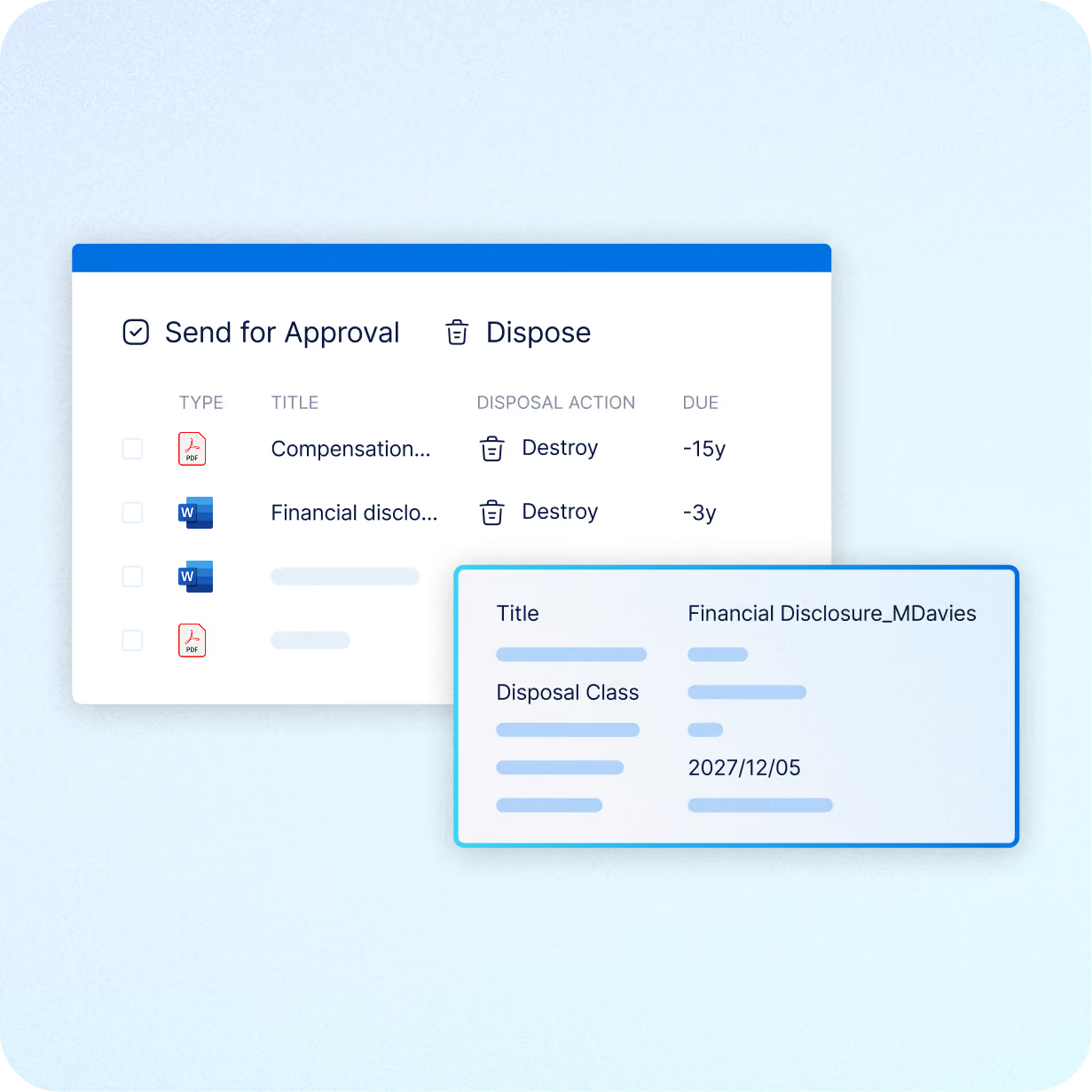
RecordPoint can help U.S. companies facilitate their NIST RMF compliance with several key features, including:
The National Institute of Standards and Technology Risk Management Framework (NIST RMF) is a guidance document for federal agencies in the United States and contractors that work with the federal government. It defines a risk management process that blends security, privacy, and information systems controls into a unified workflow to manage risk.

Lorem ipsum
Government contractors and U.S. federal agencies are the ones who must comply with the NIST RMF. For other organizations, the framework is voluntary. Regardless, to comply with the framework, companies must follow a few key steps:
To start, companies need to classify the system to be evaluated for risk. This involves categorizing the system's associated information assets based on their sensitivity and the potential impact on the organization. In practice, companies need to analyze data sensitivity and assess the potential impact on confidentiality, integrity, and availability, and ultimately assign security categories.
The next step is for organizations to choose and adapt their security controls based on the system's categorization and specific needs. In this step, reference NIST SP 800-37 to select appropriate security controls and then customize them to align with any of the system’s unique characteristics and operational environment.
The chosen security controls need to be implemented within the system. This means that organizations need to create detailed security plans that include how each control will be implemented, as well as monitored and managed. After that, teams then integrate the controls into the information system's design and operations.
Security assessments need to be conducted on a regular basis to make sure that any implemented controls are effective. Organizations need to develop a Security Assessment Plan (SAP) that defines the objectives, methods, and scope of the assessment. This plan can ensure teams can efficiently evaluate the effectiveness of controls.
After the assessment is completed, organizations need to review their findings and decide whether to adopt the policies or not. This then leads to authorizing the system, and enables teams to fine-tune any aspects of the system that don't suit the business. Reviewing findings is critical to ensure that the system is secure overall.
Lastly, organizations need a continuous monitoring plan that includes regular security assessments, vulnerability scanning, and incident response along with detection and response capabilities and other security monitoring tools. Prompt reporting of security incidents, vulnerabilities, and compliance deviations is paramount for continuous compliance. Organizations also need to take regular corrective actions to maintain compliance.
The NIST RMF is mandated for U.S. federal agencies and the contractors who work with federal agencies. As a result, violations of the RMF are adjudicated under the False Claims Act. From February 2024, the penalties for making a false claim to the US Government range from $13,946 to $27,894 per violation. It isn't uncommon for an organization to face hundreds — or even thousands — of violations in a single DOJ action.
Regulatory breakdowns, expert commentary, and real-world case studies - everything you need to decode complex NIST RMF requirements, build a defensible compliance strategy, and learn from global enforcement actions.