

Duplicate Medical Records: Overcoming the Hidden Risks
Duplicate medical records can lead to clinical errors, regulatory risks, and operational inefficiencies. Learn how to prevent and manage them.


Published:
April 21, 2023
Last updated:
Finding it hard to keep up with this fast-paced industry?
Subscribe to FILED Newsletter.
Your monthly round-up of the latest news and views at the intersection of data privacy, data security, and governance.
Subscribe Now
Overcoming the hidden risks of duplicate medical records
Duplicate records occur when the same data or file is created or stored more than once, typically due to manual input errors, disconnected systems, or inconsistent processes.
While a single duplicate record may seem harmless, they compound quickly. For example, the record duplication rate for many U.S. healthcare organizations is between 4% & 8%; for some, the rates are as high as 30%.
These duplicate records delay care, increase costs, and create serious compliance and data security risks. It’s a serious issue, but there’s good news: There are simple ways to prevent and manage duplicates.
The high cost of duplicate records
Duplicate records impact every corner of a healthcare organization. Here’s how:
Why preventing duplicate medical records matters
Duplicate records create extra work; they’re a headache for staff who rely on accurate information.
On average, removing a duplicate record can cost as much as $1,950 per incident, while prevention strategies only cost around $100 per patient.
On top of the financial cost, here are the other serious impacts that make prevention worth prioritising.
Patient and customer safety
When records don’t match, it’s harder to make the right call. Conflicting information can delay service, confuse teams, or lead to decisions based on incorrect data.
Financial impact
Duplicate records cause billing issues, transaction rejections, and gaps in reporting. This increases admin time, and it can drive up storage costs and slow down your team.
Operational inefficiency
Staff have to waste time sorting through versions, correcting mistakes, and managing workflows that should be simple.
Legal and privacy risks
Duplicate records make it harder to manage information safely across systems. It’s easier for old or unmanaged data to go missing, which can lead to non-compliance, failed audits, and accidental leaks of sensitive data.
What causes duplicate records?
Duplicate records often accumulate slowly while staff are carrying out routine tasks. A staff member might accidentally misspell a name or enter a date in a slightly different format. If the system doesn’t have a way to catch that overlap, it saves the entry as a new record.
This is especially common when systems aren’t connected. One team might update a patient’s contact details in their platform, but the change doesn’t carry over to other systems. Over time, multiple instances of the same person or medical file start to appear.
In large organizations, these issues are even more likely to occur. Data is stored in different places, and teams tend to follow their own processes. Without consistent integration or clear oversight, it’s hard to catch duplicates and even harder to clean them up.
From an IT perspective, a lack of interoperability (the ability for your systems to exchange data) is one of the main drivers of duplication, but tools like records management systems can help by linking records across platforms and reducing mismatches.

8 practical ways to prevent duplicate medical records
Preventing duplicate records takes the right combination of systems, consistent processes, and strong governance.
Here are eight practical strategies to help you reduce and eventually eliminate duplicates across your organization.

Technology-led prevention
Start by looking at the systems that store your records. If they aren’t designed to detect duplicates early, they’ll continue adding more behind the scenes.
1. Use an EMPI system
An Enterprise Master Patient Index (EMPI) links records across different systems and helps spot potential duplicates early. It gives you a single, reliable view of each person, no matter which platform you’re using.
2. Introduce a universal patient identifier (UPI)
Using a consistent ID across all systems helps stop duplicates before they start. Universal patient identifiers (UPIs) are especially useful in large networks where patients are seen in different locations or move between services.
3. Apply AI-powered record matching
Modern EMPI systems use AI to detect duplicate records faster than manual checks. These tools look at patterns across names, dates of birth, addresses, and other fields, even when the data isn’t identical. Some systems can now match records with near-perfect accuracy.

Process improvements for front-line staff
Many duplicate records begin at the point of entry. When processes aren’t consistent, it’s easy for the same person to be registered more than once.
4. Standardise registration workflows
Using a consistent intake process across all sites and systems helps prevent duplicates. This includes agreeing on required fields, setting clear rules for entering names and dates, and having a process for handling possible matches.
5. Use validation tools at the point of entry
Set up basic prompts or alerts that help staff check if a record already exists before creating a new one.
6. Train staff on what to look for
Staff should be trained to spot near-matches, ask the right follow-up questions, and understand why duplicate records cause problems. A solid onboarding session, along with occasional refreshers, can help build habits that stick.

Governance as a strategic priority
Great systems can make a huge difference, but you also need to have accountability in place.
7. Build clear policies around data quality
Set out what good looks like when it comes to entering, reviewing, and maintaining records. Make sure staff know what’s expected of them and how to follow the process, especially when working across different systems.
8. Make data quality part of performance goals
When data quality is tied to KPIs or team targets, people are more likely to take it seriously. It shifts recordkeeping from an afterthought to a talking point that helps create a culture where accuracy is the standard.
Manual vs automated duplicate prevention
Implementing automated tools is one of the most effective ways to stay ahead of duplicate records.
Even with strong processes and policies, it’s hard to keep up without systems that can flag issues in real time. Here’s how automated tools compare to manual approaches across key areas.
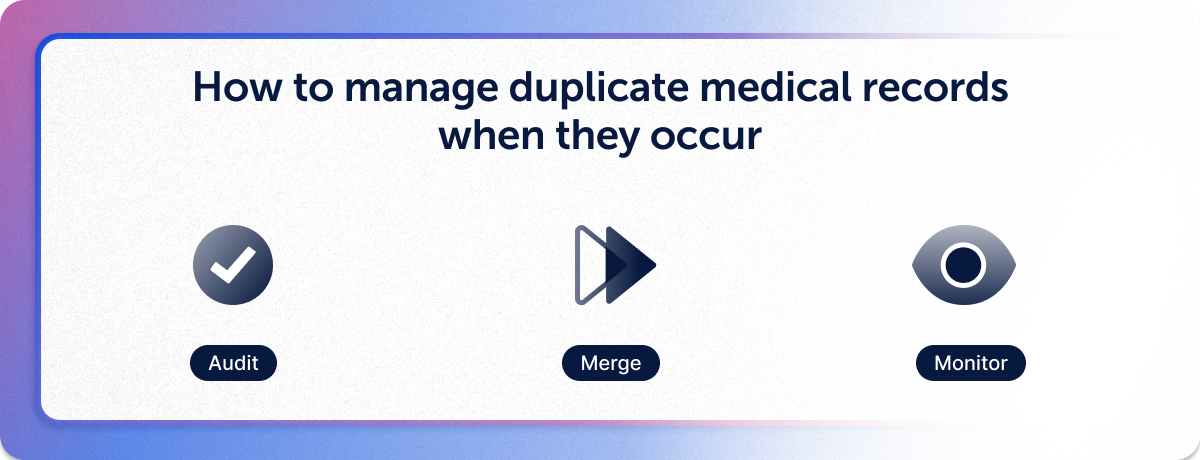
How to manage duplicate medical records when they occur
Even with strong systems in place, you can still end up with duplicate records. The key is to catch and resolve them quickly and consistently. Here are three best practices to help you manage duplicates when they pop up.
Run regular audits
Use tools that scan for patterns across names, dates, and other fields. AI-powered matching systems can flag potential duplicates faster than manual checks.
Merge records
When duplicate records are confirmed, follow a clear process for merging them. Decide which record is accurate, log any changes, and make sure there’s an audit trail. Only trained staff should make these updates.
Monitor over time
Set up dashboards and alerts to track duplicate trends. Most systems include tools to help you stay on top of this without digging through data manually.

The role of regulations and standards in preventing duplicates
Both the United States and Australia have strict regulations in place to protect patient data, and these rules make accurate, consistent recordkeeping a legal requirement.
United States: HIPAA and ONC guidelines
In the United States, HIPAA sets the standard for protecting patient privacy. If records aren’t managed properly and duplicate entries lead to mistakes or data breaches, the penalties can be hefty, with an annual maximum of $1.5 million.
The Office of the National Coordinator for Health Information Technology (ONC) also shares helpful guidelines on record matching and system integration. These resources are designed to help healthcare providers build better systems that reduce duplicates and support safer, more connected care.
Australia: The Privacy Act and My Health Record
Australia’s Privacy Act and My Health Record system require healthcare providers to manage personal information securely and accurately. Failing to prevent duplicates can lead to non-compliance, audit issues, and patient safety risks.
To reduce duplication, Australia uses Individual Healthcare Identifiers (IHIs), which are unique numbers for individuals and providers across the health system. Here’s how the system works:
- IHI: A unique 16-digit number is assigned to every person in Australia. It’s then used to link all their health records across different systems.
- HPI‑I (healthcare provider identifier, individual): Healthcare professionals, such as doctors and nurses, also have a unique number.
- HPI‑O (healthcare provider identifier, organization): This is a unique number for healthcare organizations, such as hospitals or clinics.
These efforts are part of a strategy to reduce duplicate records at scale. They’re a strong example of how standardization and regulation can support long-term data integrity.
How RecordPoint can help you with duplicate medical records
RecordPoint tackles duplicate medical records using AI-powered content matching and classification tools.
It identifies identical files across all connected systems, classifying them, and giving teams the ability to reclassify them and create a single source of truth. Power BI dashboards allow teams to monitor trends and automate notifications.
Real-world results: Historic Environment Scotland
Historic Environment Scotland (HES) was facing compliance issues due to poor data visibility and thousands of untracked or duplicate records. A review uncovered more than 500,000 duplicate files and 11,500 empty electronic records.
After introducing RecordPoint, the team completely overhauled its physical records management, reviewing every file, updating metadata, and confidently disposing of outdated content. This transformation gave the team much stronger control over their data and a clear path toward GDPR and PRSA compliance.
“It’s transformed how we manage our physical records and acted as a catalyst for that improvement.” —Ryan Kerr, Head of Information Governance, HES
The path to a single patient record
Duplicate records slow teams down, increase risk, and make it harder to deliver safe, connected care.
With records management software, organizations can reduce storage costs, meet compliance requirements, and integrate easily with systems like Microsoft 365 and SharePoint. For clinical teams, it means faster access to accurate information and better outcomes for patients.
To learn more, book a commitment-free demo with our team.
FAQs
What is the impact of duplicate patient records on healthcare delivery?
The impact of duplicate records is wide-ranging. They can delay treatment, increase the risk of medical errors, and complicate billing processes. Inconsistent or incomplete data affects both clinical documentation and your revenue cycle.
How does improving patient identification improve clinical outcomes?
Correcting patient identification reduces misdiagnoses and unnecessary repeat testing, which directly improves patient safety and improves clinical decision-making.
What are the benefits of implementing better patient identification practices?
The benefits of implementing strong patient identification workflows include fewer medical errors, better coordination of care, faster patient registrations, and a more accurate view of a patient’s medical record.
Discover Connectors
View our expanded range of available Connectors, including popular SaaS platforms, such as Salesforce, Workday, Zendesk, SAP, and many more.
Explore our connectors
Discover Intelligence Signaling
Get scalable identification of PII, PCI, duplicate records, and ROT across all your data
Learn More
Related Posts
See All