

Governing structured data: Retention, disposal and compliance across every database and warehouse
Your most sensitive records don't just live in documents and email. They live in Snowflake, Oracle, SQL Server and dozens of other structured systems — and most governance tools never reach them. The RecordPoint Structured Data Connector changes that.

.png)
Published:
June 12, 2026
Last updated:
.png)
Article Title: Governing structured data: Retention, disposal and compliance across every database and warehouse Article Type: Blog post Description / Summary: Structured data in databases and data warehouses is among the most sensitive and regulated information organisations hold — yet most governance frameworks never reach it. This article introduces the RecordPoint Structured Data Connector, explaining how it extends records-grade retention, defensible disposal and real-time PII detection across Snowflake, Oracle, SQL Server, PostgreSQL and beyond. It covers key benefits including unified governance, no-code policy management, AI-assisted data modelling, and how the connector complements tools like Snowflake Horizon Catalog, Cyera and BigID. The article also explores how RexCommand extends governance to AI systems consuming structured data. Author @type: Person name: Tristan Roberts jobTitle: Field Engineering Manager - Connectors worksFor: RecordPoint Publisher @type: Organization name: RecordPoint url: https://www.recordpoint.com Keywords structured data governance, data retention, defensible disposal, Snowflake governance, database compliance, PII detection, records management, data lifecycle management, AI governance, RexCommand Suggested Reading Time ~6 minutes
Finding it hard to keep up with this fast-paced industry?
Subscribe to FILED Newsletter.
Your monthly round-up of the latest news and views at the intersection of data privacy, data security, and governance.
Subscribe Now
Overview
Your most sensitive and regulated records increasingly live in structured systems: data warehouses such as Snowflake and Databricks, and databases such as Oracle, SQL Server, PostgreSQL, MySQL and MariaDB. Yet the governance, retention and privacy controls routinely built for documents and email rarely reach this data, leaving it outside policy and exposed to risk.
The RecordPoint Structured Data Connector closes that gap. It extends the RecordPoint data governance platform directly into your databases and data warehouses, with first class support for both cloud based sources, such as Snowflake and Google Cloud Spanner, and on-premises data sources, such as Oracle and MySQL databases. Using change data capture, the connector monitors your source systems and streams changes into RecordPoint in near real time, so every record is classified, retained and disposed of according to your policies, automatically and without engineering overhead.
The result is one governance model that spans structured and unstructured data, on premises and in the cloud, giving records, privacy and compliance teams the visibility and control they need, while freeing data engineers from manual governance requests.
Key benefits
Unified governance across all data sources
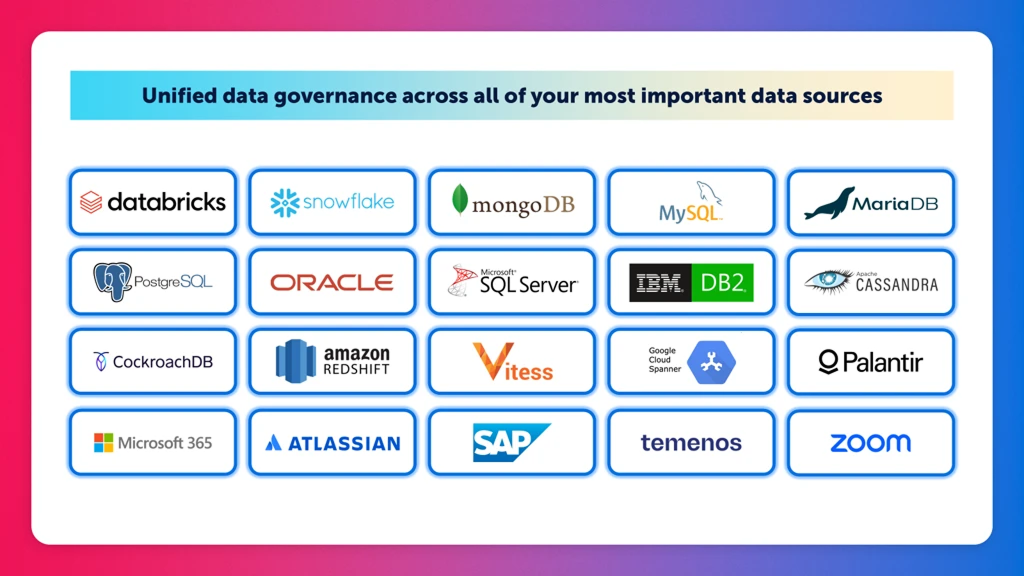
Manage structured data with the same policies, classification scheme and retention rules you already apply to Microsoft 365, file shares, CRMs and legacy systems. The connector supports large-scale data warehouses, such as Snowflake and Databricks, with the ability to manage both cloud and on-premises databases such as Oracle, SQL Server, Google Cloud Spanner, IBM Db/2, PostgreSQL, MySQL, MariaDB and others. Governance operates at the object and row level, going deeper than table level controls, so you can manage precisely the data that matters.
Plus, retention controls and data models can be seamlessly copied from one data source to another, such as applying the same controls to the source database and upstream warehouse, with a single-click. RecordPoint’s connector automatically converts the SQL to match the target system.
Manage retention and detect PII through a business user portal
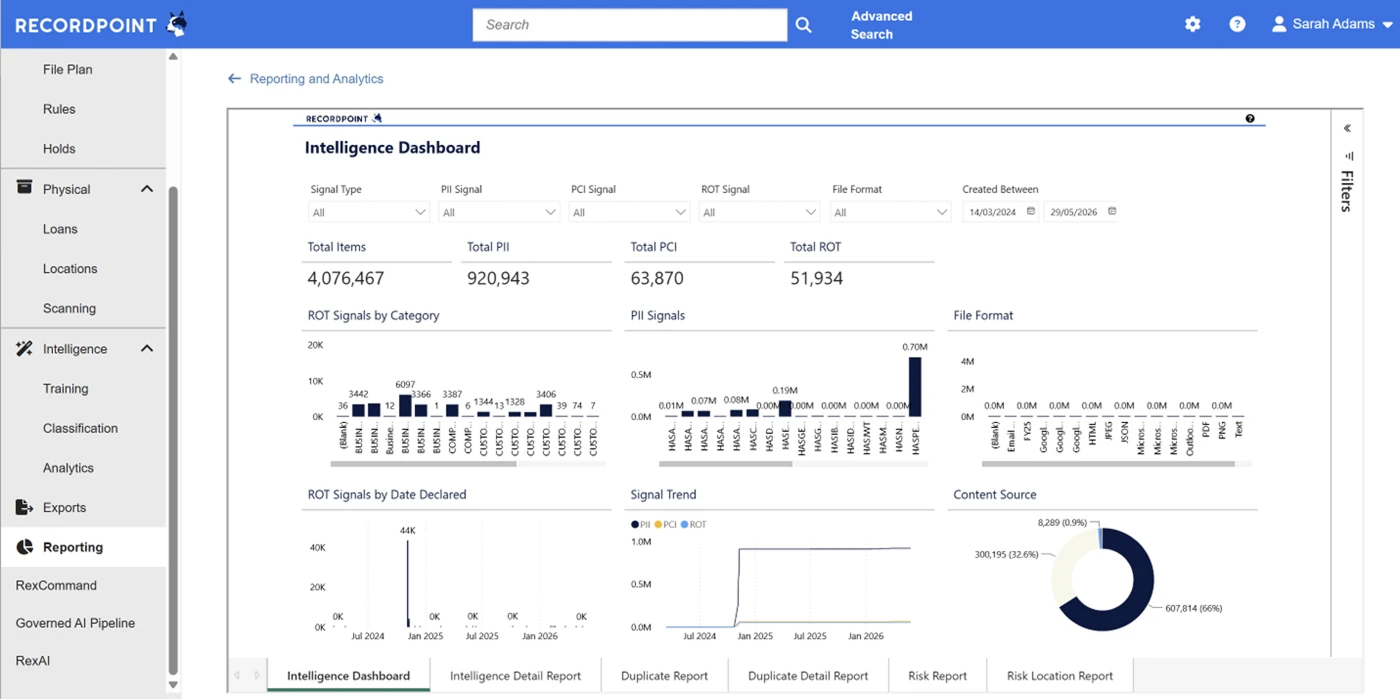
Records, privacy and compliance teams define and apply policy in a no-code portal, without writing SQL or raising engineering tickets. RecordPoint’s AI-powered Intelligent Signals automatically identifies personal, sensitive and regulated data as it arrives, and dashboards give a real time view of what data exists, where it lives, how sensitive it is and where it sits in its retention lifecycle. Governance becomes a self service capability for the teams accountable for it, enabling compliant and auditable destruction workflows that are business-driven. This enables true compliance for regulated industries, far beyond basic schema-level controls or cron-scheduled deletions without approvals.
AI enabled data modelling to accelerate time to compliance
Large estates are complex and a single organisation can have several thousand entities to bring under management, yet each entity can span tens or even hundreds of tables. RecordPoint uses your AI to model your data, suggesting which entities to manage, how they map to the underlying tables, the metadata required for governance, and generating the queries needed to retrieve and dispose of records. Work that once took months of manual scoping can be completed in days, shortening your time to compliance.
Full control over the destruction or redaction process
Disposal is fully configurable. Choose to permanently destroy records or to redact specific fields, with the behaviour mapped to your retention schedule and business classification scheme. Legal holds are honoured, and every action is captured in a defensible audit trail. Nothing is destroyed without policy and approval, so when an auditor asks why a record was disposed of, you have a clear and provable answer.
Full visibility across your data estate from within Snowflake
Governed metadata from every connected source is consolidated in Snowflake, so you can query across your entire data estate from a single place. Combined with cross platform lineage and keyword and semantic search, this gives you a unified view of where sensitive data lives, how it moves and how it is being used, from the environment your data teams already work in.
Deploy anywhere
The connector is built to run wherever your data does, with all dependencies bundled and configuration that is fully portable. Credentials are protected with strong, built in encryption.
How it compares
The RecordPoint Structured Data Connector is designed to complement the tools you may already use rather than simply replace them. The distinction is consistent: many platforms focus on discovering and cataloguing data or on data quality, while RecordPoint focuses on retention and compliance, and on acting on data through governed retention and defensible disposal.
Extend with RexCommand to govern your Snowflake AI usage
Once your structured data is governed, the next question is how AI uses it. As teams adopt AI on this data, including Snowflake Cortex AI, governance has to extend to the AI systems themselves. RexCommand is RecordPoint's AI governance layer, giving organisations complete AI visibility and provable control.
RexCommand brings every AI system into one governed view, including Cortex AI, approved tools, and AI embedded in third party products. It establishes a clear acceptable use policy, applies that standard through repeatable approval workflows, and captures audit ready evidence aligned to frameworks such as the NIST AI Risk Management Framework, the EU AI Act and ISO/IEC 42001.
Because the same platform governs both the data and the AI that consumes it, you can trace which governed datasets feed each AI system, assess sensitivity and exposure, and demonstrate that AI is governed in practice, not just in policy. Structured data governance and AI governance become one continuous capability.
- See AI as it exists: Identify AI systems across the organisation, including Snowflake Cortex AI and AI operating outside formal approval.
- Understand data exposure: Trace which governed datasets power each AI system to assess sensitivity, lineage and downstream risk.
- Set and prove the standard: Define acceptable use, enforce it through approval workflows, and capture defensible, audit ready evidence as standards evolve.
Discover Connectors
View our expanded range of available Connectors, including popular SaaS platforms, such as Salesforce, Workday, Zendesk, SAP, and many more.
Explore our connectors
Related Posts
See All